
Affiliate links — we may earn a commission
Last updated: October 2026. Procedures checked in October 2026 on borger.dk, nyidanmark.dk, lifeindenmark.borger.dk, skat.dk, su.dk and rejsekort.dk. A few links are affiliate links, marked as sponsored. You never pay extra, and each step also links to a full guide that lists options we earn nothing from.
When I moved to Aarhus as an international student, I got almost every one of these forms wrong at least once. What nobody tells you is the order: everything waits for your CPR number, and half of it then waits for MitID. This is the list I wish someone had handed me at the airport.
Quick answer
When you arrive in Denmark as a student, do things in this order:
- Before you arrive: secure housing, and apply for your residence document (EU/EEA) or residence permit (non-EU).
- Day 1: get a prepaid Danish SIM, which needs no CPR number.
- Week 1: register for your CPR number at Citizen Service or an International Citizen Service (ICS) centre. The rule is within 5 days of having an address and a residence document.
- Weeks 1 to 2: set up MitID, open a bank account (it becomes your NemKonto) and check Digital Post.
- Weeks 2 to 4: health card and doctor, internet, electricity, contents insurance, transport, Danish classes, and an a-kasse if you qualify.
- Once you have a job: check your tax card, then apply for SU if you meet the worker rule.
The CPR number unlocks almost everything else, so book that appointment as soon as you have an address.
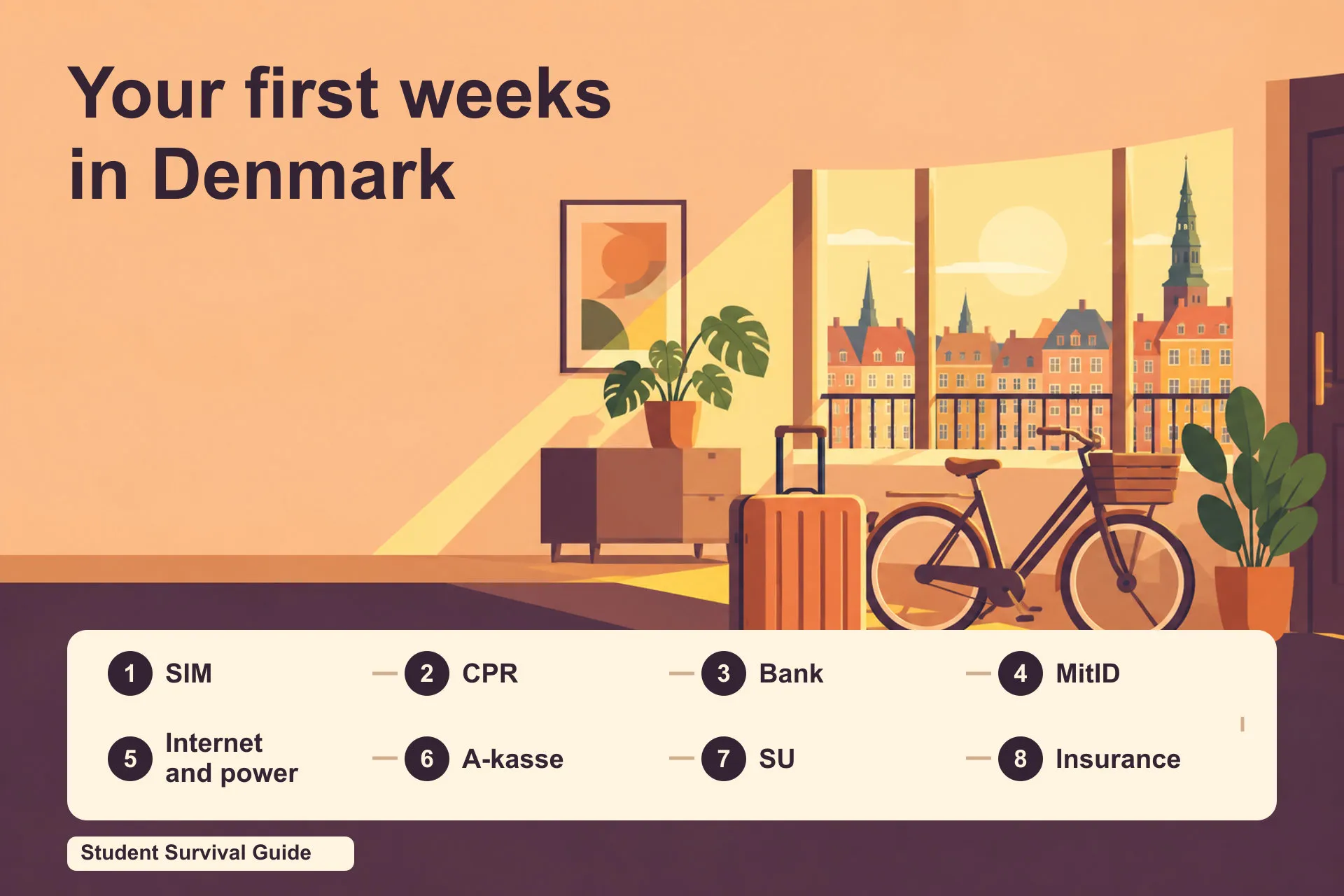
Your first 30 days at a glance (printable checklist)
Print this table or screenshot it. Each row links to the step below.
| When | Task | You need | Done |
|---|---|---|---|
| Before arrival | Housing contract | Deposit and prepaid rent | ☐ |
| Before arrival | EU residence document or residence permit | Passport, admission letter | ☐ |
| Before arrival | EU health card (EHIC) or travel insurance | From your home country | ☐ |
| Day 1 | Prepaid SIM | Nothing Danish | ☐ |
| Week 1 | CPR registration | Passport, residence document, housing contract | ☐ |
| Week 1 to 2 | MitID | CPR, passport | ☐ |
| Week 1 to 2 | Bank account and NemKonto | CPR, ID, address | ☐ |
| Week 1 to 2 | Digital Post | MitID | ☐ |
| Week 2 to 3 | Yellow health card and doctor | Arrives by post | ☐ |
| Week 2 to 4 | Internet | Address, usually CPR and MitID | ☐ |
| Week 2 to 4 | Electricity | Address, usually MitID | ☐ |
| Week 2 to 4 | Contents insurance | CPR | ☐ |
| Week 2 to 4 | Transport (Rejsekort app) | Phone, payment card | ☐ |
| Week 2 to 4 | A-kasse | CPR, proof of studies | ☐ |
| Week 2 to 4 | Apps and Danish classes | MitID | ☐ |
| With a job | Tax card | MitID, job | ☐ |
| With a job | SU application | CPR, MitID, NemKonto, 10-12 hours a week of work (EU) | ☐ |
Before you arrive
Housing before you arrive
What: a signed contract for a room, dorm (kollegium) or flat. Why: you can’t get a CPR number without a Danish address, and you can only register once you’ve moved in. How: apply early through your university’s housing office and the student housing portals in your city. Make sure the contract shows your full name and the exact address, because the municipality uses it to register you. Never pay a deposit for a place you haven’t seen without checking the landlord: rental scams are common at semester start.
While you’re at it, sign up for the public housing portals in your city (for example AarhusBolig in Aarhus). Most use waiting-list seniority, so the earlier you join, the better your chances when you need a cheaper or bigger place later.
Our guide: how to find student accommodation in Denmark.
Residence document or permit
What: your legal right to stay. EU/EEA and Swiss students need an EU residence document for stays over 3 months. Non-EU students need a residence permit for studies, granted before you travel. Why: you need it before you can get a CPR number. How (EU/EEA): fill in the online form OD1A and attach your passport or ID, your admission letter and a signed declaration on financial self-support. Then show up in person at SIRI or an ICS centre within 30 days. There is no fee, and if your papers are complete, it can be issued on the spot. Official link: SIRI: EU residence document for students (nyidanmark.dk). Non-EU students start at nyidanmark.dk.
Health cover until your yellow card arrives
EU/EEA students should bring the blue European Health Insurance Card (EHIC) from their home country. It covers necessary care until your Danish yellow card is in place. Non-EU students should have travel or health insurance for the first weeks. Your Danish public cover starts from your CPR registration date, not from the day the card arrives.
What to pack
Bring your passport, admission letter, housing contract and any residence papers in print and on your phone. Pack a laptop (almost all teaching and exams are digital), a proper rain jacket and warm layers, and bedding for the first night. Most dorm rooms come empty. You can furnish cheaply later: see furnishing a student room on a budget.
Week 1
Day 1: a Danish phone number
What: a prepaid Danish SIM. Why: you’ll need a Danish number for appointment confirmations, your bank and university, and almost every subscription needs CPR and MitID, which you don’t have yet. How: buy a prepaid starter pack in a supermarket or kiosk. Lyca and Lebara are the usual choices with no contract. Lyca says registration is optional. Later, move to a cheaper big-data plan and keep the same number.
Skip the phone salespeople with stands on busy shopping streets. Their deals are rarely better than what you find online in five minutes.
Our guide: best and cheapest SIM cards in Denmark, which also compares non-affiliate brands.
CPR number and registration
What: your CPR number (personnummer), Denmark’s personal ID number. You get it by registering your address in the Civil Registration System. Why: you need it for a bank account, MitID, the health system, a tax card, SU, a library card and most subscriptions. How:
- You must register if you’ll stay more than 3 months (6 months for Nordic citizens). Under borger.dk’s rules, you register with your municipality’s Citizen Service (borgerservice) within 5 days of having both an address and a residence document or permit.
- You must turn up in person. Bring your passport, your residence document or permit, your housing contract and your admission letter. The municipality decides exactly which documents it wants.
- Many cities have an International Citizen Service (ICS) centre that handles EU residence documents, CPR and MitID in one place: ICS East in Copenhagen (International House), ICS West in Aarhus, ICS South in Odense, ICS North in Aalborg, plus Esbjerg and Sønderborg. You must book an appointment first, and slots fill up in August. Some universities run their own registration days with the municipality, so check your welcome email.
- Some municipalities ask non-EU students to apply for the CPR number online first and then book the in-person appointment.
Official links: borger.dk: moving to Denmark (in Danish) and Life in Denmark: International Citizen Service.
If your appointment is weeks away, check the booking system for cancellations, because slots do open up.
Weeks 1 to 2
MitID
What: MitID is your digital ID. You use it to log in to your bank, skat.dk, minSU, borger.dk and the health system. Why: almost nothing digital works without it, including SU applications and most internet and electricity sign-ups. How: with a CPR number, you can usually create MitID in the MitID app by scanning the chip in your passport. This needs an NFC phone and a passport from an accepted country. Some municipalities say to wait 24 hours after getting your CPR number. If the app route fails, book an appointment at Citizen Service or ICS and bring your passport. Official link: mitid.dk.
Never approve a MitID request you didn’t start yourself. MitID and bank scams by SMS and phone are common, and no bank or authority will ever ask you to approve something over the phone.
Bank account and NemKonto
What: a Danish bank account. Your first account is registered as your NemKonto, the account the state pays into. Why: SU, tax refunds and many salaries are paid into your NemKonto, and Danish employers and landlords expect a Danish account. How: choose a bank and apply in the app or at a branch with your CPR number, ID and proof of address. Some banks also want your admission letter or job contract. If one bank says no, try another. Digital banks such as Lunar let you open an account in the app, while traditional banks (Danske Bank, Nordea, Jyske Bank, Arbejdernes Landsbank and others) offer English-language service at many branches. A Revolut or Wise account can bridge the gap until then, but it usually isn’t a NemKonto.
Once you have a Danish account, set up Betalingsservice for recurring bills such as rent, internet and insurance. Check that each bill actually shows as registered there, because the first one or two invoices often still arrive to be paid manually.
Digital Post
Once you have a CPR number, official letters from your municipality, Skat, SU and the health system arrive in Digital Post, not your letterbox. Log in with MitID at post.borger.dk or in the mit.dk app, and turn on notifications so you don’t miss a deadline.
Weeks 2 to 4
Yellow health card and doctor
What: the yellow health card (sundhedskort) shows your CPR number and your assigned GP (doctor). Why: you show it at the doctor, hospital and pharmacy. Your GP is the way into all non-emergency care. How: it arrives by post, usually about two weeks after registration. You can also use the digital card in the Sundhedskortet app with MitID. You can change doctor on borger.dk if the one assigned is far away. Call 112 in an emergency. In the Capital Region, call 1813 before going to an emergency department outside your doctor’s hours.
Our guide: health care in Denmark for international students.
Internet at home
What: a home internet subscription. Why: dorms often include internet, private rentals rarely do. How: check your contract first. If you need your own, decide how long you’ll stay at the address. Fibre is fastest but can come with binding or installation conditions. 5G home internet is a plug-in router that works the day it arrives and moves with you, which suits students who change rooms every year. OiSTER and eesy both sell 5G home internet. Most providers need CPR and MitID to order.
Our guide: how to choose an internet package, which compares fibre, cable and 5G.
Electricity
What: your electricity supplier, if power isn’t included in the rent. Why: if you don’t choose one, you’re supplied by a default company for your area, which is rarely the cheapest. How: you can choose any supplier, and switching is free. Most online sign-ups end with MitID confirmation, so do this once MitID works. Read your meter on move-in day and keep a photo.
Our guide: best and cheapest electricity providers in Denmark.
Contents insurance
What: contents insurance (indboforsikring) covers your belongings against theft, fire and water damage, and usually includes liability if you damage someone else’s things. Why: bike theft is common in Danish cities, and your bike can often be covered. The yellow health card doesn’t cover your belongings, and it doesn’t cover you abroad either. How: first check whether your union, a-kasse or study programme offers a student package. Otherwise, compare a few quotes, for example through Tjenestetorvet, which sends you offers from several insurers at no cost. Add travel insurance before your first trip home.
Our guides: contents insurance for students and travel insurance.
Transport: Rejsekort app and bike
What: how you pay for buses, trains and the metro. Why: the old plastic Rejsekort was switched off in summer 2026. Advice from before then is out of date. How: use the Rejsekort app (check in and out on your phone), the new physical Basiskort, or buy single tickets in the Rejsebillet app. If you commute to campus every day, compare a youth or commuter pass. In most student cities, a second-hand bike from Facebook groups or DBA is the cheapest way to get around. Learn the cycling rules first, because fines are steep. Official link: rejsekort.dk guides.
Our guide: cheapest ways to use public transport in Denmark.
A-kasse
What: an a-kasse is a Danish unemployment insurance fund. Membership is voluntary. Why: joining while you study builds the membership time you need to claim benefits (dagpenge) after you graduate. Student membership is usually free for up to five years if you meet the fund’s conditions (a qualifying education, an income ceiling that includes SU, and residence). How: join online with CPR and proof of enrolment. Do it early, because with at least one year of continuous membership, eligible graduates can qualify from the day after they finish.
Be careful: membership does not guarantee benefits. You also need Danish at PD2 level or about 600 paid working hours, you must tell your a-kasse within 14 days of finishing, and your residence basis must allow benefits. Holders of SIRI’s job-seeking permit for graduates are not allowed to receive them. Check the conditions on borger.dk.
Our guides: what an a-kasse is and the rules for internationals, and the a-kasse comparison for students.
Apps and Danish classes
Once MitID works, install the apps you’ll use every week: MitID, your bank, MobilePay, mit.dk (Digital Post), Sundhedskortet, Rejsekort and your university app. Our must-have apps in Denmark list covers them.
Sign up for Danish classes at the municipal language centre early. The Danish education programme is free, but students pay a refundable deposit (2,000 kr in Copenhagen and Aalborg) and the right to free classes is time-limited. See Copenhagen’s programme page or your own municipality’s. Danish opens up far more student jobs, and later it’s one route to graduate unemployment benefits.
Join your university’s intro week, student clubs and sports. Most of the friends, flatmates and student-job tips you’ll get in the first year come from there.
Once you have a job
Tax card
What: Denmark uses a digital tax card linked to your preliminary income assessment (forskudsopgørelse). Why: without the right tax card, your employer withholds too much tax, or too little, and you pay it back later. How: log in to E-tax (TastSelv) on skat.dk with MitID and enter your expected income for the year. Your main card (hovedkort) holds your tax-free allowance (54,100 kr for most people in 2026) and should go to your biggest income. Use the secondary card (bikort) for a second job. If you get both SU and a salary, decide which one gets the main card, then make sure your estimate covers both. Your employer fetches the card digitally from Skat. You pay 8% labour market contribution (am-bidrag) on salary even with a tax-exemption card. Official link: skat.dk: the Danish tax cards.
Our guide: taxes in Denmark for students. Finding work first? Read how to find a student job.
SU, the Danish student grant
What: SU is a monthly state grant for students. Why: for EU/EEA students who qualify, it’s worth several thousand kroner a month on top of your salary. How: EU/EEA and Swiss students usually qualify as workers: a paid job of at least 10 to 12 hours every week, for at least 10 continuous weeks, kept up while you get SU. Non-EU students generally qualify only through the Danish rules (for example 2 years of work or 5 years of residence in Denmark). Apply in minSU with MitID, then complete the equal status application within 3 weeks. Apply by the last day of the month you want SU from, because it’s never paid for earlier months. Official link: su.dk: foreign citizens.
Our guide: how to apply for SU, step by step.
Money traps to avoid in your first month
- Wrong tax card. It’s the most common way students end up owing Skat money. Check your preliminary income assessment every time your income changes.
- Scam SMS and calls. Don’t click links in unexpected messages about payments or parcels, and never share or approve MitID. If in doubt, look up the company’s official number yourself.
- Signing up on the street. Phone and charity sellers on shopping streets rarely offer the best deal. Compare online first.
- Throwing away bottles and cans. Most drink containers carry a deposit (pant), marked A, B or C. Return them to the machines in supermarkets for money off your shopping.
- Spending the deposit money. Your next move will cost several months of rent upfront as deposit and prepaid rent. Put a little aside each month from day one.
FAQ
What should I do first when I arrive in Denmark as a student?
Get a prepaid SIM and confirm your CPR appointment. Almost everything else, from your bank account to MitID and SU, waits on the CPR number.
How do students get a CPR number?
Register in person at your municipality’s Citizen Service or an International Citizen Service centre. Bring your passport, residence document or permit, housing contract and admission letter. You must have moved into your address, and you should register within 5 days of having both an address and a residence document.
How long does it take to get a CPR number?
You usually get the number at the appointment itself, or soon after. The appointment wait is the slow part in August and January. The yellow health card follows by post, usually after about two weeks.
Do EU students need a residence document to get a CPR number?
Yes, for stays over 3 months. Apply for the EU residence document with SIRI’s online form OD1A, then show up at SIRI or an ICS centre within 30 days. It’s free.
Can I open a bank account without a CPR number?
Usually not a normal Danish account. Use your home bank, Revolut or Wise for the first weeks, then open a Danish account, which becomes your NemKonto, once you have CPR.
Can I get a SIM card without a CPR number?
Yes. Prepaid SIMs from Lyca or Lebara don’t need CPR. Most subscriptions need CPR and MitID, so switch once you’re registered.
Do I need an a-kasse as a student?
It’s not mandatory, but it’s usually free while you study and it’s the condition for claiming graduate benefits. Check that your residence basis allows benefits before you count on them.
Is internet included in Danish student housing?
Often in dorms (kollegier), rarely in private rentals. Check your contract before you order anything.
Last checked: October 2026. Rules, appointment systems and processing times change, especially around semester start. Check with your municipality, ICS centre and university for your own situation.