
Affiliate links — we may earn a commission
I’m a big advocate of investing, and the most important step is the first one. On SU the amounts are small, which is fine. Here’s how I’d set it up.
Quick answer
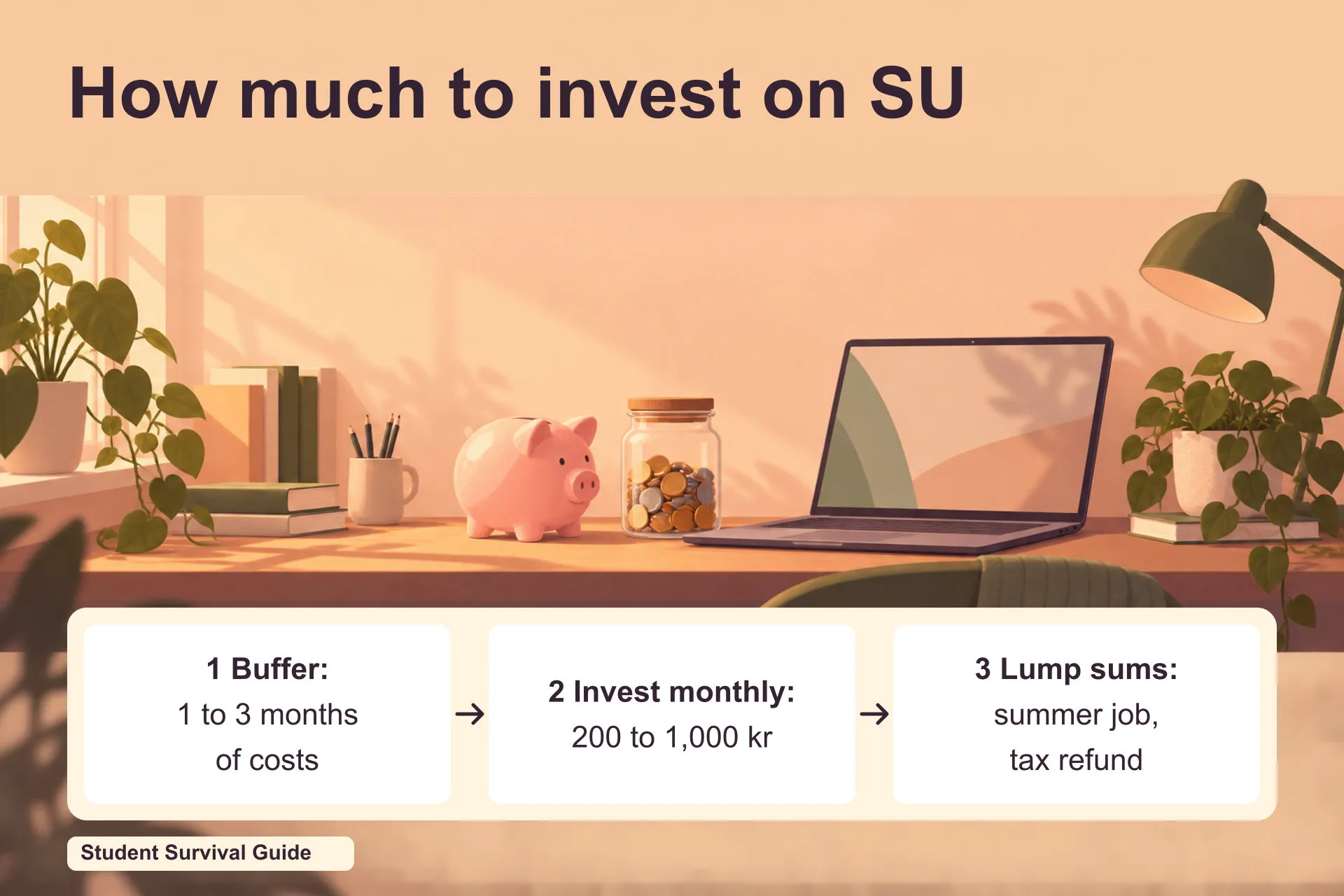
Save a buffer of one to three months of expenses first. Then invest a fixed amount every month that you won’t need back for at least five years. For most students on SU that’s somewhere between 200 and 1,000 kr a month. Invest extra from summer jobs and tax refunds as lump sums. Don’t invest SU loans or any money you’ll need this semester.
Step 1: the buffer
A buffer is money in a normal savings account for things that will happen: a broken laptop, a deposit for a new room, a month without shifts. Without one, a surprise bill forces you to sell investments at a bad moment, or to borrow.
A practical target for a student is one to three months of living costs. If you spend 7,000 kr a month, that’s 7,000 to 21,000 kr. Build it before you invest, or at least alongside, putting most of each month’s savings into the buffer until it’s full.
Step 2: what’s left each month
Write down a normal month: SU and salary in, rent, food, transport, phone and subscriptions out. What’s left at the end is what you can actually save. Be honest; if it’s 300 kr, start with 300 kr.
| Monthly surplus | Suggested split |
|---|---|
| Under 500 kr | Build the buffer first; invest once it’s full |
| 500 to 1,500 kr | Half to the buffer until it’s full, half invested |
| Over 1,500 kr | Buffer full? Invest most of it, keep a little for planned costs like travel |
The exact numbers matter less than doing it every month. An automatic transfer on the day SU arrives makes it happen without willpower.
Step 3: invest the same amount every month
Investing a fixed amount monthly means you buy more when prices are low and less when they’re high, and you never have to guess the right moment. Most Danish platforms let you set up a monthly savings plan into a fund. Our index funds guide explains what to buy.
Watch the trading fee. With a 25 kr minimum fee, buying for 200 kr costs 12.5%. Choose a platform and product with low or no fee on small monthly purchases, or invest every second or third month instead.
What 500 kr a month can become
Investing 500 kr a month for 10 years is 60,000 kr paid in. If the investments grew 6% a year, a long-run average for global stocks that is never guaranteed, it would be worth about 82,000 kr before tax. Some years will be negative. Over five years or more, broad stock funds have historically come out ahead of a savings account, but not every time.
Lump sums: summer jobs and tax refunds
Students often earn most in the summer or get a tax refund (overskydende skat) in spring. Top up the buffer first, then invest the rest in one go or spread it over a few months.
Where to start
Open an aktiesparekonto: gains are taxed at only 17%, and for a student amount the 174,200 kr limit is far away. Read the aktiesparekonto guide, or compare platforms in the main investing guide. Nordnet and Saxo both offer one.
FAQ
Can I invest my SU?
You can invest the part of your SU grant you don’t need to live on. Don’t invest SU loans: you pay interest on them, and investments can fall.
Is it worth investing only 200 kr a month?
Yes, if the fees are low. The habit matters more than the amount, and you can raise it when your income goes up.
Should I pay off my SU loan before investing?
SU loans carry interest from the day you take them, and repayment starts after you finish. If the loan’s interest rate is higher than what you can reasonably expect from investing, taking less loan is the safer return. Check your rate at minSU.
Last checked: October 2026. Returns are examples, not predictions. Investments can lose value.