
Affiliate links — we may earn a commission
You don’t need to pick winning companies to invest. A broad index fund is how I’d recommend most students start, and this part explains what to look for.
Quick answer
An index fund buys every company in a market index, like the world’s large companies, so you own a small piece of thousands of businesses in one purchase. For Danish investors there are two kinds: Danish index funds (investeringsforeninger), which are simple to buy and tax, and ETFs traded on the stock exchange, which are often cheaper but need checking against SKAT’s positive list. Either fits in an aktiesparekonto, as long as an ETF is on the list.
What an index fund does
Instead of picking companies, an index fund copies an index. A global index fund holds over a thousand companies across the US, Europe and Asia. When one company has a bad year, it barely moves the fund.
That’s why most beginner advice points to a broad, global index fund:
- Spread across thousands of companies and many countries.
- Low cost, because nobody is paid to pick stocks.
- Nothing to follow: you buy it every month and leave it.
Danish index funds vs ETFs
| Danish index fund (investeringsforening) | ETF | |
|---|---|---|
| Where you buy it | Through any Danish bank or broker | On a stock exchange, through a broker |
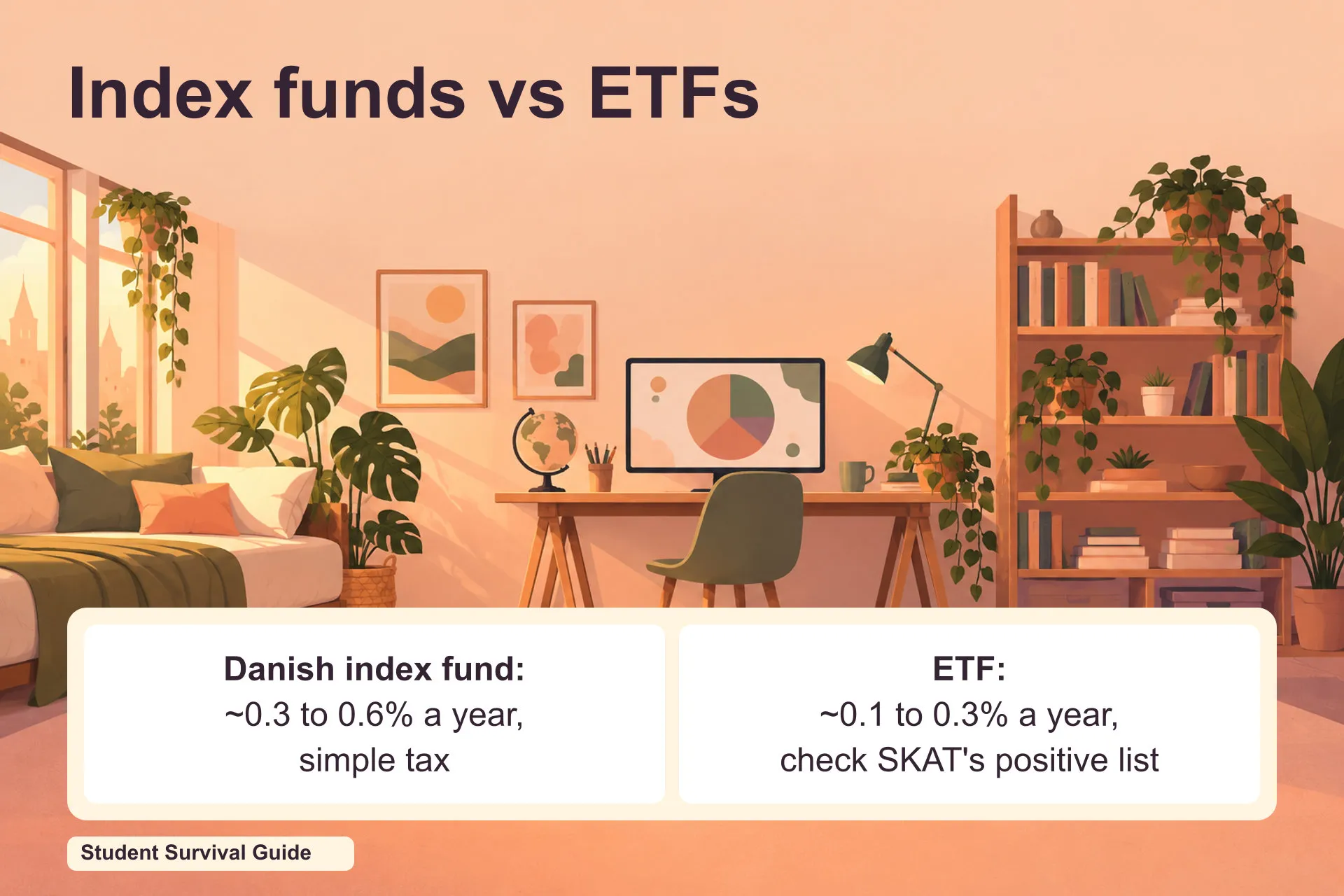
| Typical yearly cost (ÅOP) | Roughly 0.3% to 0.6% for global index funds | Roughly 0.1% to 0.3% for the largest global ETFs |
| Tax outside an aktiesparekonto | Usually simple; many pay out dividends and are taxed as share income | Taxed every year on the gain (lagerbeskatning); share income only if on the positive list |
| Monthly savings plans | Widely available | Available at some brokers |
The cost difference sounds small, but over 20 years 0.3% a year adds up. The tax difference matters more if you invest outside an aktiesparekonto.
SKAT’s positive list
SKAT’s positive list (positivlisten) is a list of funds and ETFs that are taxed as share income (aktieindkomst). It matters in two ways:
- In an aktiesparekonto, you can only hold ETFs that are on the list.
- In a normal investment account, an ETF on the list is taxed as share income at 27% or 42%. An ETF that isn’t on the list is taxed as capital income, which is usually worse.
Every ETF, on the list or not, is taxed on the yearly gain even if you don’t sell. Search the list for the fund’s ISIN code, a 12-character ID shown on every fund page, before you buy. Skattestyrelsen publishes the list on its website.
Choosing a first fund
Look for:
- A broad global index: “global”, “world” or “all-world” in the name.
- Low yearly cost (ÅOP).
- On SKAT’s positive list, if it’s an ETF.
- Accumulating (reinvests dividends) or distributing (pays them out). In an aktiesparekonto it makes little difference to your tax.
- Available in a monthly savings plan at your broker, without a high minimum fee.
Fund names, costs and the positive list change, so check the current details on your broker’s fund page before you buy.
Where to buy
Nordnet and Saxo both sell Danish index funds and ETFs inside an aktiesparekonto. Lysa picks index funds for you, but outside the aktiesparekonto. The main investing guide compares the platforms.
FAQ
Are ETFs better than Danish index funds?
ETFs are often cheaper, while Danish index funds are simpler for tax outside an aktiesparekonto. Inside an aktiesparekonto, both are taxed at 17%, so cost and convenience decide.
What is ÅOP?
ÅOP (årlige omkostninger i procent) is the total yearly cost of a fund as a percentage of your money. Lower is better.
Can I buy an ETF that isn’t on the positive list?
Yes, in a normal investment account, but gains are taxed as capital income. You can’t hold it in an aktiesparekonto.
How many funds do I need?
One broad global index fund is enough to start. Adding more funds rarely adds much spread.
Last checked: October 2026. Cost ranges are approximate. Check the current ÅOP and the positive list before you buy.