
Affiliate links — we may earn a commission
Danish investment tax looks complicated until you see it laid out. With a Danish broker it mostly takes care of itself; with a foreign one, you do the paperwork. Here’s the whole picture.
Quick answer
In 2026, gains on shares and stock funds are taxed as share income (aktieindkomst): 27% up to 79,400 kr a year, 42% above. In an aktiesparekonto everything is taxed at 17% instead. ETFs are taxed every year on the gain even if you don’t sell, and an ETF that isn’t on SKAT’s positive list is taxed as capital income. With a Danish bank or broker, all of this is reported for you. With a foreign broker like eToro, you report it yourself.
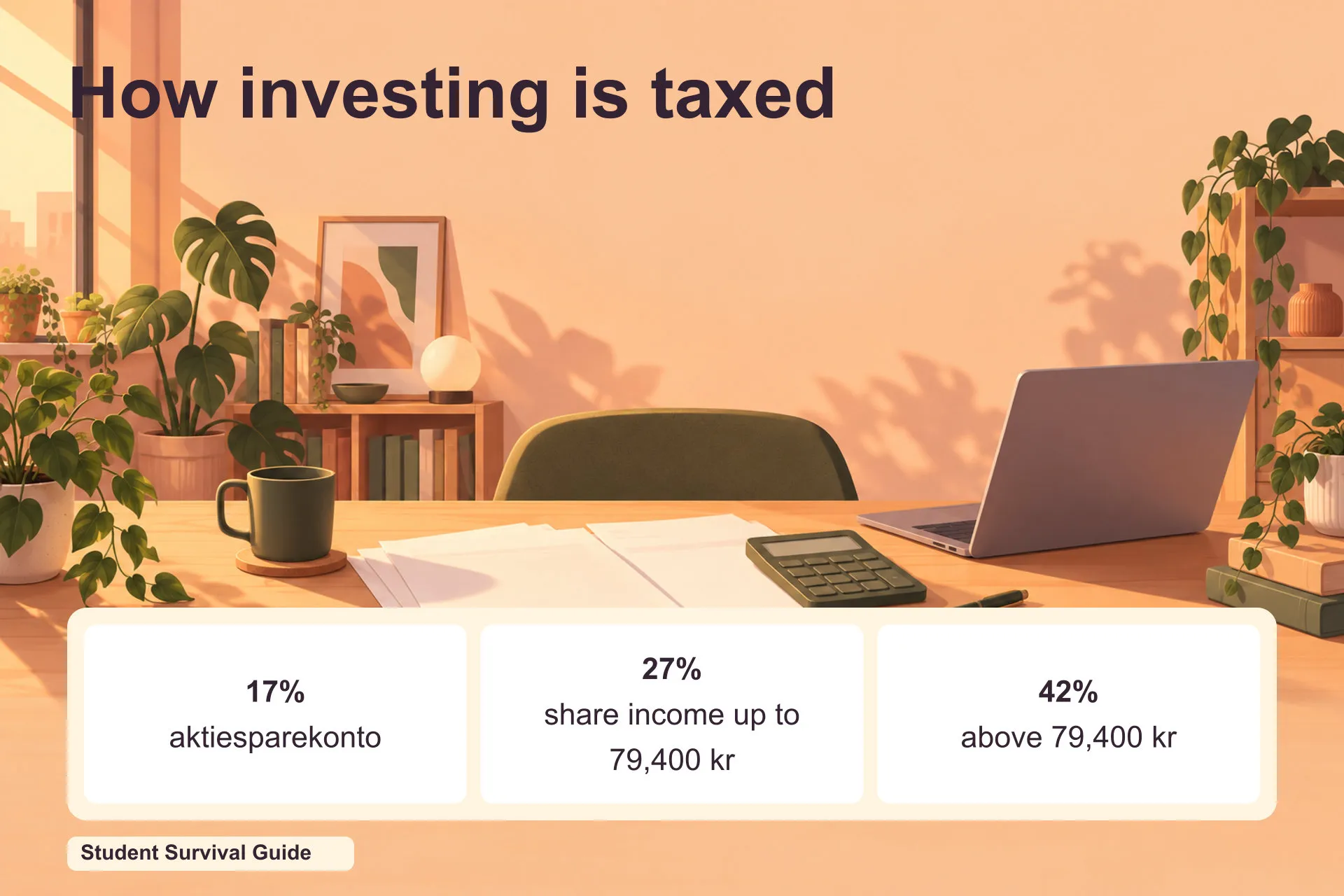
The three rates
| Where the gain comes from | Income type | Tax in 2026 |
|---|---|---|
| Anything inside an aktiesparekonto | Special rate | 17% |
| Shares, Danish stock funds, ETFs on the positive list (normal account) | Share income (aktieindkomst) | 27% up to 79,400 kr, 42% above |
| ETFs not on the positive list, bond funds, CFDs | Capital income (kapitalindkomst) | Taxed with your other income; usually higher than 27% for a positive gain |
For most students, investing amounts stay well under 79,400 kr of gains a year, so the 27% rate applies outside an aktiesparekonto.
When you pay: sale or every year
Danish tax uses two principles:
- Realisation (realisationsprincippet): you pay tax when you sell. This applies to individual shares and many Danish stock funds in a normal account.
- Lagerprincippet: you pay tax every year on the change in value, even if you haven’t sold. This applies to all ETFs and to everything in an aktiesparekonto.
Under the lagerprincip, a good year means a tax bill without any cash from a sale, and a bad year gives you a loss to carry forward.
Dividends
Dividends from Danish shares are taxed as share income, and the company withholds tax before you receive them. Dividends from foreign shares are often taxed in the company’s country too; Denmark gives credit for some of it, but reclaiming the rest can be a hassle. In an aktiesparekonto, dividends are part of the yearly 17% calculation.
Who reports it
Danish banks and brokers like Nordnet and Saxo report your gains, losses and dividends to Skattestyrelsen. The numbers appear in your tax assessment (årsopgørelse); you only need to check them.
Foreign brokers don’t. If you invest with eToro, Lysa or a broker in another country, you enter gains, losses and dividends yourself in TastSelv each spring. Brokers usually provide a yearly tax report to help. Forgetting it can lead to a back-tax bill later, because foreign platforms share account information with tax authorities under international agreements.
Losses
Losses on listed shares can be set against gains on listed shares, and unused losses carry forward to later years. Losses in an aktiesparekonto stay in the aktiesparekonto. The rules for setting losses against other income types are stricter; check Skattestyrelsen’s guidance if you have a large loss.
Leaving Denmark
If you leave Denmark, you stop being fully taxable here. An aktiesparekonto can’t continue, and in some cases leaving with large unrealised gains triggers exit tax. Ask your bank before you move, and check the rules in your new country.
FAQ
Do I pay tax if I don’t sell?
On ETFs and in an aktiesparekonto, yes: tax is due on the yearly gain. On individual shares in a normal account, only when you sell.
Is the aktiesparekonto always better?
For most students, yes: 17% is lower than 27%. The exception is if you have losses you want to use against other share income.
Do I need to report eToro gains myself?
Yes. eToro doesn’t report to Skattestyrelsen, so you enter your gains, losses and dividends in your tax return.
Last checked: October 2026. Thresholds change every year. See Skattestyrelsen’s guides on share income and the aktiesparekonto for the official rules.