
From November onwards, your Danish classmates, colleagues and sports club will start talking about two things: julefrokost and pakkeleg. One is a “Christmas lunch” that often starts in the evening and ends at sunrise. The other is a dice game where people steal presents from each other. Here’s what to expect from both, so you can say yes to the invitation and actually enjoy it.
Quick answer
- Pakkeleg (“the package game”) is a Danish Christmas gift game. Everyone brings a small wrapped gift, you take turns rolling a dice, and a six lets you take a gift. In the second round a six lets you steal one, until a hidden timer goes off. The closest English equivalent is a White Elephant or Yankee Swap gift exchange, but with dice.
- Julefrokost (“Christmas lunch”) is the Danish Christmas party, held with colleagues, classmates, clubs or family from mid-November to early January. It’s usually an evening of traditional food, snaps and a lot of singing, despite the name. In English, call it a Christmas party or Christmas dinner.
How to play pakkeleg: the rules
This is what pakkeleg looks like (Tan played it at OneUnit).
What you need
- One or more small wrapped gifts per person. The host decides how many. The fun is in the wrapping and the surprise, not the value.
- One or two dice. More dice speed things up in a big group.
- A timer that nobody can see, usually a phone set by the host to a random time between 5 and 15 minutes.
Round 1: collecting the gifts
- Put all the gifts in a pile in the middle of the table.
- Sit in a circle and pass the dice round. Each person rolls once.
- Roll a six and you take a gift from the pile. Anything else, pass the dice on.
- Keep going until the pile is empty. Some players will have several gifts and some none. That’s the point.
Round 2: stealing
- The host starts the hidden timer.
- Keep rolling. A six now lets you steal a gift from any other player.
- When the timer goes off, the game ends. Whatever is in front of you is yours, and you can finally unwrap it.
Players without a gift at the end go home empty-handed. Danes find this hilarious, so don’t take it personally.
Common variations
Every group has its own house rules. Two you’ll often meet:
- Roll a one: you must give one of your gifts to the person on your left (or right).
- Roll a double with two dice: everyone passes all their gifts one place to the left.
Ask the host about the house rules before the dice come out.
How much should a pakkeleg gift cost?
The group agrees on a budget, and it’s usually small: a few gifts of around 20 to 50 DKK each is typical. Good choices are funny, edible or useful: Christmas sweets, a lottery scratch card (skrabelod), a tiny bottle of snaps, socks, a candle. Wrap them well, because the wrapping is half the game.
Discount supermarkets and Flying Tiger are where most Danes buy pakkeleg gifts. Our guide to the cheapest supermarkets in Denmark has the chains to check.
What is julefrokost?
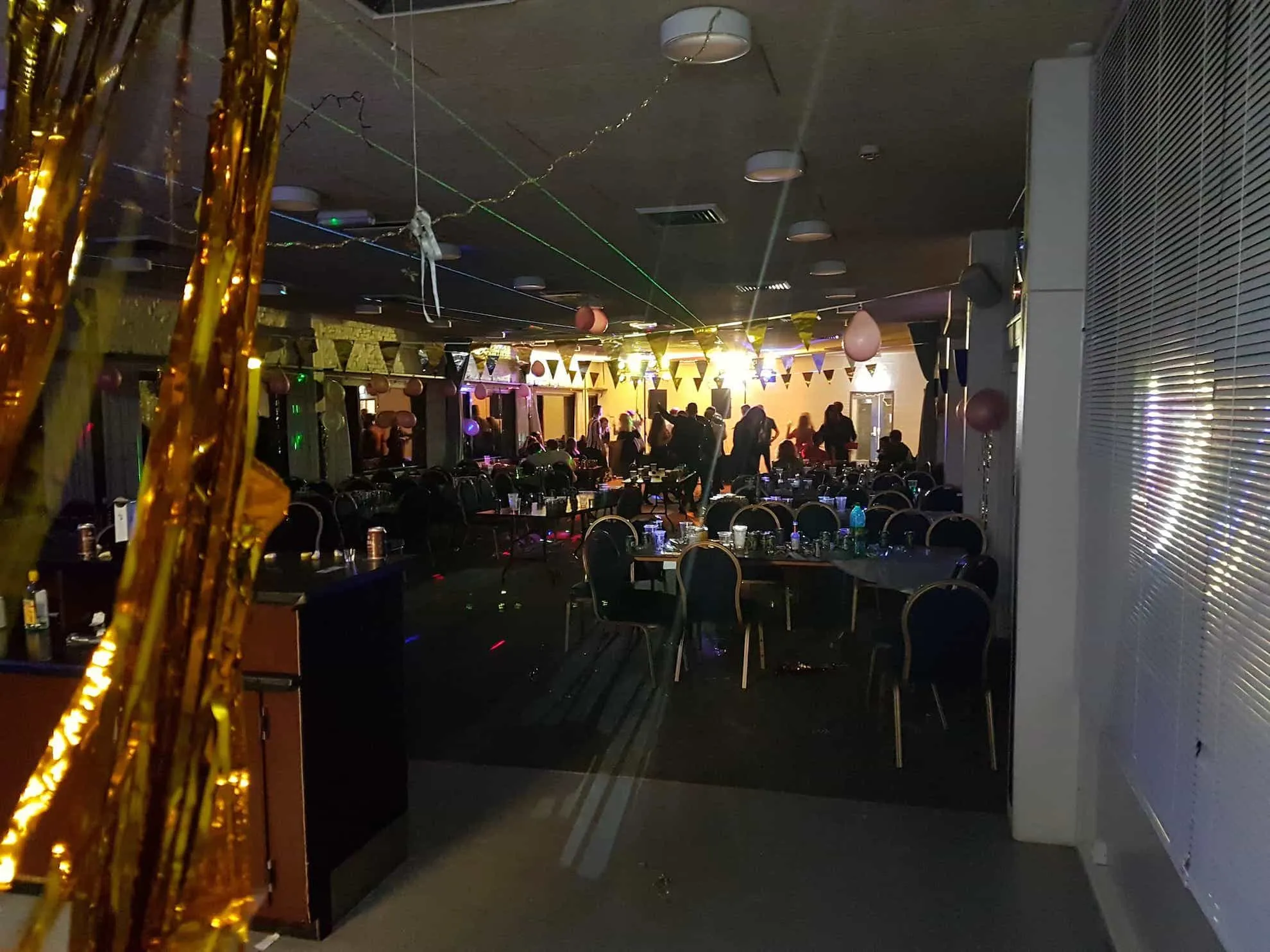
Lunch at 7 pm? This was the annual julefrokost at VIK badminton.
Julefrokost literally means “Christmas lunch”, but most are dinner parties that start in the late afternoon or evening and carry on late. Danes usually go to several each season: one with work, one with their study programme or student bar, one with a sports club and one with family.
When is julefrokost season?
Mostly Fridays and Saturdays from mid-November to just before Christmas. Because December gets so busy, getting invited in November or even January is completely normal. For a lot of Danes the season unofficially starts on J-dag, the first Friday of November, when Tuborg’s Christmas beer is released in the evening.
What do you eat?
A traditional julefrokost is a long buffet eaten in courses, with rye bread (rugbrød):
- Herring (sild) first, pickled or curried, with onion and capers. Always eaten first, and the reason the snaps comes out early.
- Warm and cold dishes next: fish fillets with remoulade, liver pâté (leverpostej), meatballs (frikadeller), roast pork with crackling (flæskesteg) and red cabbage.
- Cheese and dessert to finish, often risalamande (rice pudding with almonds and cherry sauce).
What do you drink?
Snaps (or akvavit), a strong grain spirit flavoured with herbs, served ice cold in tiny glasses. Someone will shout skål and everyone drinks together while looking each other in the eye. Christmas beer (julebryg) fills the gaps.
You don’t have to drink. Saying “nej tak” to snaps is fine, and saying it early saves you being offered another glass every ten minutes. A glass of water or a soft drink in your hand helps.
Julefrokost etiquette for internationals
- Say yes. Danes can feel reserved during the year, and julefrokost is where colleagues and classmates relax. It’s one of the best chances you’ll get to make Danish friends.
- Expect songs. Song sheets are handed out, often with new lyrics to old melodies. Sing along, even if you’re only guessing the pronunciation.
- What happens at julefrokost stays at julefrokost. That’s the saying, anyway. Leave when you’ve had enough; nobody will mind if you slip out after midnight.
- Plan the way home. Check the last train or night bus before you go. Our guide to public transport in Denmark covers Rejsekort and the night services.
Danish Christmas snacks to bring along
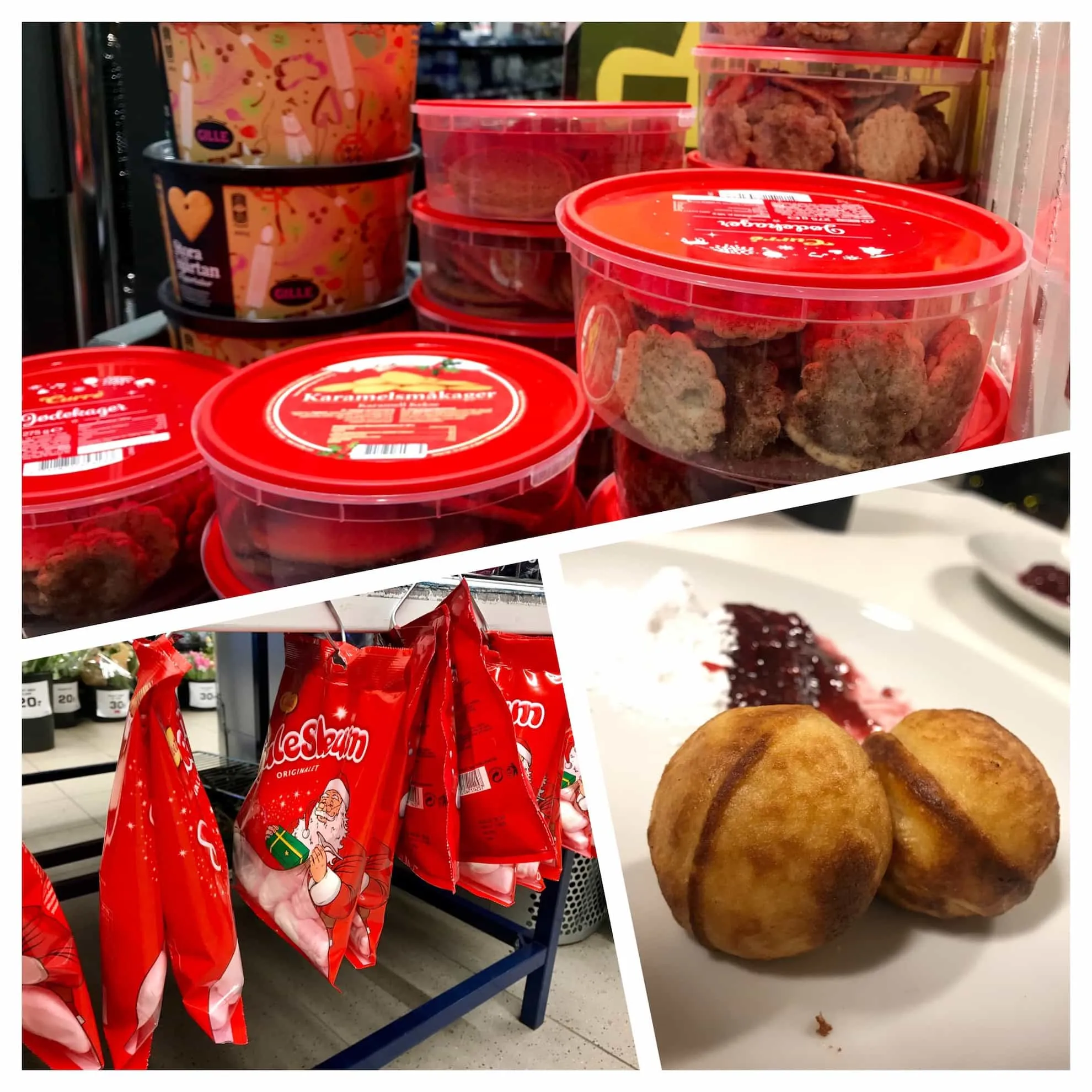
Æbleskiver, juleskum, vaniljekranse and brunkager?
If you’re asked to bring something, or you’re hosting your own hygge evening, these are the classics:
- Æbleskiver: round pancake balls, served warm with jam and icing sugar. Often with gløgg, the Danish mulled wine with raisins and almonds.
- Vaniljekranse and brunkager: butter cookies and thin spiced biscuits, sold in tins in every supermarket from November.
- Pebernødder: tiny spiced cookies, eaten by the handful.
- Juleskum and snebolde: foam Christmas candy and coconut-covered marshmallow balls, for the sweet tooth.
FAQ
What does pakkeleg mean?
Pakke means package and leg means game, so pakkeleg is “the package game”: a Christmas gift game played with a dice.
What is pakkeleg in English?
There’s no direct translation. You can call it “the Danish dice gift game”. English speakers will recognise it as a version of a White Elephant or Yankee Swap gift exchange, where stealing gifts is part of the fun.
What is julefrokost in English?
Literally “Christmas lunch”, but it works like a Christmas party: a workplace, club or family gathering with a long traditional meal, usually in the evening. “Christmas party” or “Danish Christmas dinner” is the best English translation.
How long does pakkeleg last?
Usually 15 to 30 minutes in total. Round one lasts until all gifts are taken; round two runs on a hidden timer, often set between 5 and 15 minutes.
Do I have to bring a gift to play pakkeleg?
Yes. Everyone who plays brings the agreed number of gifts. If you forgot, ask the host whether you can still join; most groups will let you watch and laugh instead.
Is julefrokost always in December?
No. The season runs from mid-November to early January, and many workplaces hold theirs in November or January to avoid the December rush.
What should I wear to a julefrokost?
Ask the organiser. Workplace parties are usually smart-casual, while student and club parties often have a theme or Christmas sweaters.
Want more Danish Christmas? Read how to celebrate Christmas Eve like a Dane and what to expect on Danish New Year’s Eve.